Articulated Hoist: The Engineering Behind Curved Monorail Beams
Designing an overhead lifting system usually starts with a straight line, the simplest path between point A and point B. But modern factory layouts and complex material handling routes often force a load to travel around corners − a job built for an articulated hoist.
Bending a curve into a monorail beam takes specialised engineering and purpose-built lifting equipment to handle the added stresses safely, which is what Condra delivers. Here is everything you need to know about traversing curved monorail beams safely and efficiently.
What Is an Articulated Hoist?
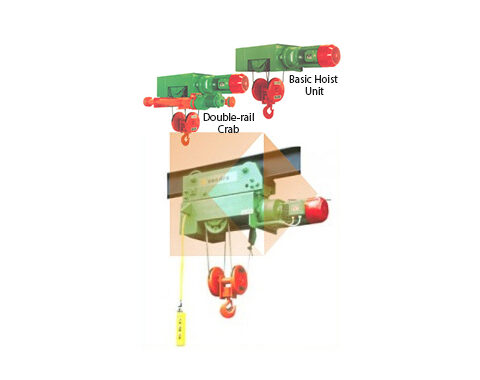
A standard hoist uses a rigid trolley framework built for straight beams. Introduce a curve, and a rigid trolley will jam or cause serious structural damage to both the hoist and the beam. An articulated hoist features a pivot or swivelling mechanism built into its trolley assemblies. This lets the leading and trailing wheels pivot independently, so the hoist can negotiate horizontal curves and bends in the monorail track without losing stability or lifting capacity.The Pros and Cons of Bending a Curve into a Monorail Beam
Altering a standard structural beam to include a curve comes with operational trade-offs:- The Pros: The main advantage is continuous material flow. A curved monorail beam removes the need for expensive transfer stations or extra cranes to move a load around obstacles or between production bays. It saves floor space and keeps production moving.
- The Cons: Bending a beam introduces structural challenges. It takes specialised manufacturing precision to keep the beam level through the bend. Curves also introduce centrifugal and torsional forces, or twisting stresses, that straight tracks don’t experience. This calls for heavier support structures and more rigorous engineering calculations. Wear on the beam flanges also increases if the system doesn’t use the correct hoist.
Why a Standard Hoist Won’t Work
A standard hoist cannot be forced around a bend. A lifting system running on a curved track needs a hoist built for articulation. Without the ability to pivot, a rigid trolley suffers severe flange friction, causing rapid wear and accelerated track degradation. Binding can also make the hoist jerk or stall, creating a serious safety hazard with a suspended load.Driving Factors: Radius and Degrees
When engineering a curved monorail crane system, two critical geometric factors dictate the design of both the beam and the hoist:The Radius of the Curve
The radius is the measurement from the centre of the turn to the beam. A tight radius, basically a sharp turn, places immense stress on the track and requires a highly specialised, tightly pivoting articulated trolley. A larger, more gradual radius allows for smoother travel and less mechanical wear, but requires more physical space in the facility. As an original equipment manufacturer (OEM), Condra has to know the minimum radius a hoist can handle to ensure it won’t bind.The Degrees of the Turn
The degrees, for example, a 45°, 90°, or 180° bend, determine how long the hoist will be negotiating the curve. The greater the angle, the longer the hoist is subjected to the lateral and torsional forces of the turn. This impacts structural calculations for the beam supports and dictates the layout of power feeding systems, such as flexible trailing cables or curved festoons.Purpose-Built Solutions by Condra
At Condra, we design, engineer and manufacture custom lifting equipment for complex factory layouts, including articulated hoists engineered for tight bends and heavy-duty articulation. Our team will consult with you to ensure your exact geometric specifications are met, covering concept design through installation. Trust Condra – we specialise in lifting equipment for demanding industries.